


TON’s explosive growth in 2026 - driven by deep Telegram integration, seamless mobile onboarding and a rapidly expanding user base - has created unprecedented demand for fast and reliable cross-chain transfers. With millions of users entering Web3 directly through their messaging app, TON has become a mainstream gateway to crypto activity, and bridging now plays a central role in connecting this massive user flow to liquidity across EVM networks. As more capital circulates between TON and established ecosystems like Ethereum, BNB Chain and Polygon, users expect transfers that feel effortless, predictable and immediate.
To meet this demand, bridge providers have significantly upgraded their infrastructure over the past year. Security frameworks have been tightened through multi-proof validation, more frequent audits and better safeguarding of routing logic. Token support has expanded to include the most actively used assets across the TON ecosystem, particularly stablecoins that dominate payment flows. Combined with improvements in execution speed and fallback mechanisms, these upgrades ensure that bridging maintains stable performance even during intense spikes in network activity.
TON’s high throughput gives it a natural advantage for consumer-facing applications, microtransactions and real-time payments, but this potential can only be realized when cross-chain connectivity remains smooth. Users moving funds from EVM chains expect bridging to work without additional complexity, confusing fees or inconsistent execution times. For retail users who may be interacting with Web3 for the first time, even small friction points can disrupt adoption. Reliable bridging therefore becomes a key structural component of TON’s continued expansion.
This updated 2026 list highlights the bridges that deliver the most stable, transparent and scalable routes between TON and the broader multi-chain environment. These solutions stand out not only for their technical performance, but also for their strong UX and resilience under high traffic - all qualities necessary to support TON’s rapidly growing liquidity needs.
Below are the five top cross-chain bridges currently facilitating TON transactions.
Defiway Bridge
Defiway is the only bridge that supports transactions between TON and 10+ other blockchains, including Ethereum, BNB, Tron, Solana, and Polygon. It provides a fixed fee structure and unlimited volume support, making it ideal for traders and institutions handling large transactions.
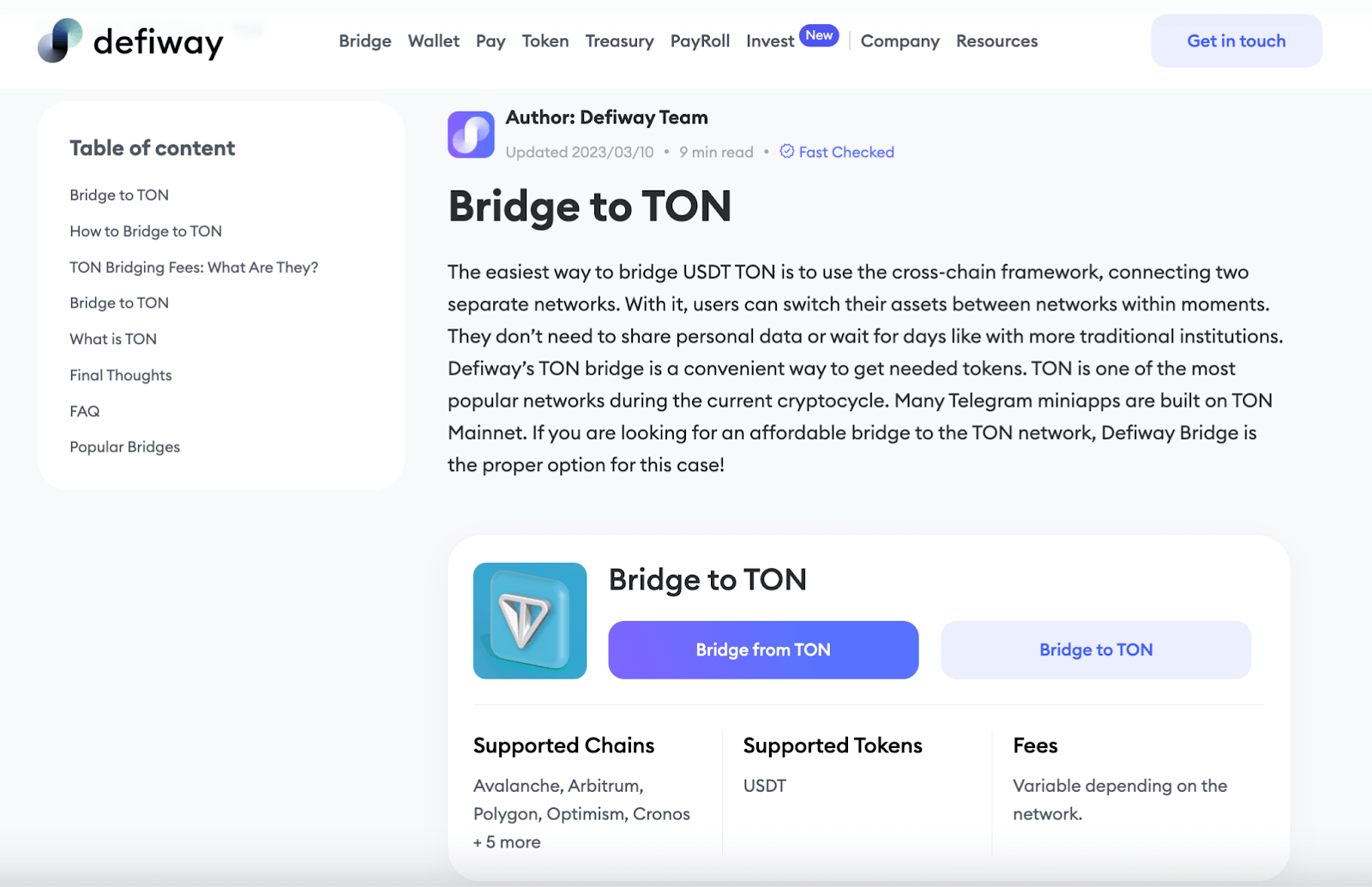
Key Features
- Supports 10+ blockchains, including major EVM and non-EVM networks.
- Fixed fee model ensures transparency.
- Unlimited transaction volumes.
- Smart contract audited by Certik, ensuring security.
- No major security breaches reported in nearly two years.
With the rising demand for low-cost, high-speed cross-chain transactions, Defiway is emerging as a go-to solution for liquidity providers and DeFi users.
Symbiosis Finance
Symbiosis Finance provides fast, efficient, and cost-effective bridging through a pool-based liquidity model. This approach optimizes transactions, making it more affordable than some conventional bridging mechanisms.
Key Features
- Supports a wide range of blockchains.
- Optimized for speed and cost efficiency.
- User-friendly interface with an intuitive design.
- Actively developing new features for improved user experience.
Symbiosis is a great choice for users who prioritize speed and efficiency while bridging assets across networks.
TON Bridge
TON Bridge is the official bridge developed by the TON Foundation, ensuring high reliability and seamless integration within the TON ecosystem.
Key Features
- Directly supported by the TON Foundation.
- Provides TON-ETH and TON-BNB transfers.
- Highly secure and officially endorsed.
- Limited token support, primarily focusing on major assets.
This bridge is perfect for those looking for a trustworthy and direct TON-native solution with strong ecosystem backing.
Rubic Exchange
Rubic functions as a best-rate aggregator, scanning multiple DEXs and bridges to ensure users get the most cost-effective swaps.
Key Features
- Aggregates liquidity from multiple DEXs.
- Ensures users receive the best rates for cross-chain swaps.
- User-friendly interface for quick transactions.
Rubic is an excellent tool for traders looking for automated and efficient rate comparison without manual searching.
SimpleSwap
SimpleSwap offers a straightforward swapping experience with minimal complexity, making it perfect for beginners.
Key Features
- Supports a vast range of cryptocurrencies.
- Designed for convenience and simplicity.
- Not the most competitive rates, but ideal for quick swaps.
For users prioritizing ease of use over deep liquidity or best rates, SimpleSwap remains a solid option.
Trends & Industry Insights
The blockchain industry is undergoing rapid transformation, with interoperability emerging as a central theme. Here are some of the key trends shaping the space:
- Rising Adoption of Cross-Chain Bridges: With more blockchains being developed, interoperability solutions are essential for ensuring liquidity and functionality across networks. A report from Messari highlights that over $60 billion in assets are now transferred via cross-chain bridges.
- Security Remains a Top Priority: High-profile bridge hacks, such as the Wormhole and Ronin breaches, have caused losses exceeding $1 billion. As a result, projects are placing greater emphasis on security audits and decentralized validation mechanisms.
- Shift Toward Fixed-Fee Models: As gas fees fluctuate across networks, more bridges, including Defiway, are adopting fixed-fee structures to provide greater cost predictability for users.
- Integration with Layer 2 Solutions: More bridges are starting to integrate with Layer 2 scaling solutions like Arbitrum and Optimism to reduce transaction costs and improve scalability.
- Regulatory Scrutiny: Governments are increasingly monitoring cross-chain activities to prevent illicit transactions. Compliance-friendly bridges are emerging to cater to institutional users.
Conclusion
Among the various options available, Defiway stands out as the most reliable and efficient cross-chain bridge for the TON blockchain. Its support for more than ten major blockchains, transparent fixed fees, and unlimited volume capabilities make it a preferred choice for both institutional and retail users. Additionally, its security measures, including a Certik-audited smart contract, ensure safe transactions.
As TON adoption continues to rise, Defiway’s role in driving interoperability and liquidity within the blockchain space will only become more critical. For users looking for a dependable, fast, and cost-effective cross-chain bridge, Defiway remains the top choice.
FAQ
1. What is a TON cross-chain bridge?
A TON cross-chain bridge is a protocol that allows users to transfer assets between The Open Network (TON) and other blockchain ecosystems. Bridges help move liquidity across networks and enable access to applications that are not available on TON.
2. Why are TON bridges important?
TON continues to attract new users through its ecosystem and Telegram integration. Cross-chain bridges make it possible to move assets between TON and other blockchain networks, improving liquidity and interoperability.
3. Which networks can TON be bridged to?
Supported destinations depend on the bridge you choose. Many TON bridge providers support transfers between TON and major ecosystems such as Ethereum, BNB Chain, Polygon, Arbitrum, Base, Tron, and other blockchain networks.
4. What should I consider when choosing a TON bridge?
Key factors include supported networks, transfer speed, transaction fees, security practices, liquidity availability, and overall user experience. Choosing a well-established bridge can help reduce operational risks.
5. Are TON cross-chain bridges safe?
Bridge security varies between protocols. Users should look for bridges with audited smart contracts, transparent security practices, and a proven operational history. As with any blockchain transaction, users should verify all transfer details before confirming.
6. How long does a TON bridge transaction take?
Transfer times depend on the bridge, network congestion, and the source and destination blockchains. Some transfers can be completed within minutes, while others may require additional confirmation time.
7. What fees are charged when bridging assets from TON?
The total cost may include bridge fees and blockchain network fees. Fees vary depending on the selected route, transferred asset, and current network conditions.
8. Can I bridge TON-based stablecoins to other blockchains?
Many bridges support stablecoin transfers between TON and other blockchain ecosystems. Availability depends on the specific bridge, token, and supported liquidity routes.
9. What should I do if my TON bridge transaction is pending?
Check the transaction status using the bridge interface, your wallet, or the relevant blockchain explorer. If the transaction remains pending longer than expected, contact the bridge provider and provide the transaction hash.
10. Which TON bridge is best for beginners?
For most users, the best bridge is the one that combines broad network support, transparent fees, a straightforward interface, and strong security practices. The bridges listed in this article represent some of the most widely used options in the TON ecosystem.