

Solana enters 2026 with one of the strongest performance profiles in the entire crypto landscape, consistently delivering high throughput, ultra-low transaction fees and an ecosystem that continues to grow across trading platforms, gaming projects and user-focused consumer applications. As liquidity becomes increasingly multi-chain, users expect bridging routes that feel nearly instantaneous and integrate seamlessly with Solana’s high-speed environment. The demand is no longer only for fast transfers - users now look for predictable execution, transparent fees and routes that remain stable even during peak on-chain activity.
In response to this growing demand, bridge providers have intensified their infrastructure upgrades. Routing engines have been refined to minimize execution delays, reduce slippage and adapt dynamically to network conditions. Security frameworks have become stricter, with more frequent audits and improved validation layers designed to protect high-value transfers. Support for major assets - especially stablecoins and blue-chip tokens - has expanded to ensure that liquidity can move fluidly across ecosystems. These improvements allow Solana bridges to maintain reliability even as transaction volume continues to increase year after year.
Because Solana powers real-time applications and high-frequency trading environments, stable bridging is essential for preserving market efficiency and user experience. Any delay, congestion or inconsistency in cross-chain transfers can disrupt capital flows that depend on Solana’s speed. For traders, DeFi participants, gaming economies and consumer apps, reliable bridging becomes a foundational requirement rather than an optional feature. As a result, bridge providers are investing heavily to match Solana’s performance standards and ensure smooth interoperability with other major ecosystems.
This updated 2026 ranking highlights the bridges that offer the fastest, most secure and most predictable pathways into Solana. These solutions stand out not only for their technical quality, but also for their user-centered design and strong resilience under high load - all essential characteristics for supporting Solana’s expanding role in the multi-chain economy.
What is Solana
Solana has seen a surge in popularity among memecoins, with several projects gaining significant traction. This can be attributed to several factors:
- Low transaction fees: Solana's low transaction costs make it an attractive platform for memecoin developers and investors.
- High-speed transactions: Solana's fast transaction times allow for quick and efficient trading of memecoins.
- Strong community: The Solana community has been enthusiastic about supporting memecoin projects, driving their growth.
- Speculative nature: Memecoins are often driven by speculation and hype, and Solana's popularity has made it a fertile ground for such projects.
But considering that most crypto investors keep their funds in popular EVM networks, users really need good bridges between Solana and EVMs.
Top Solana bridges
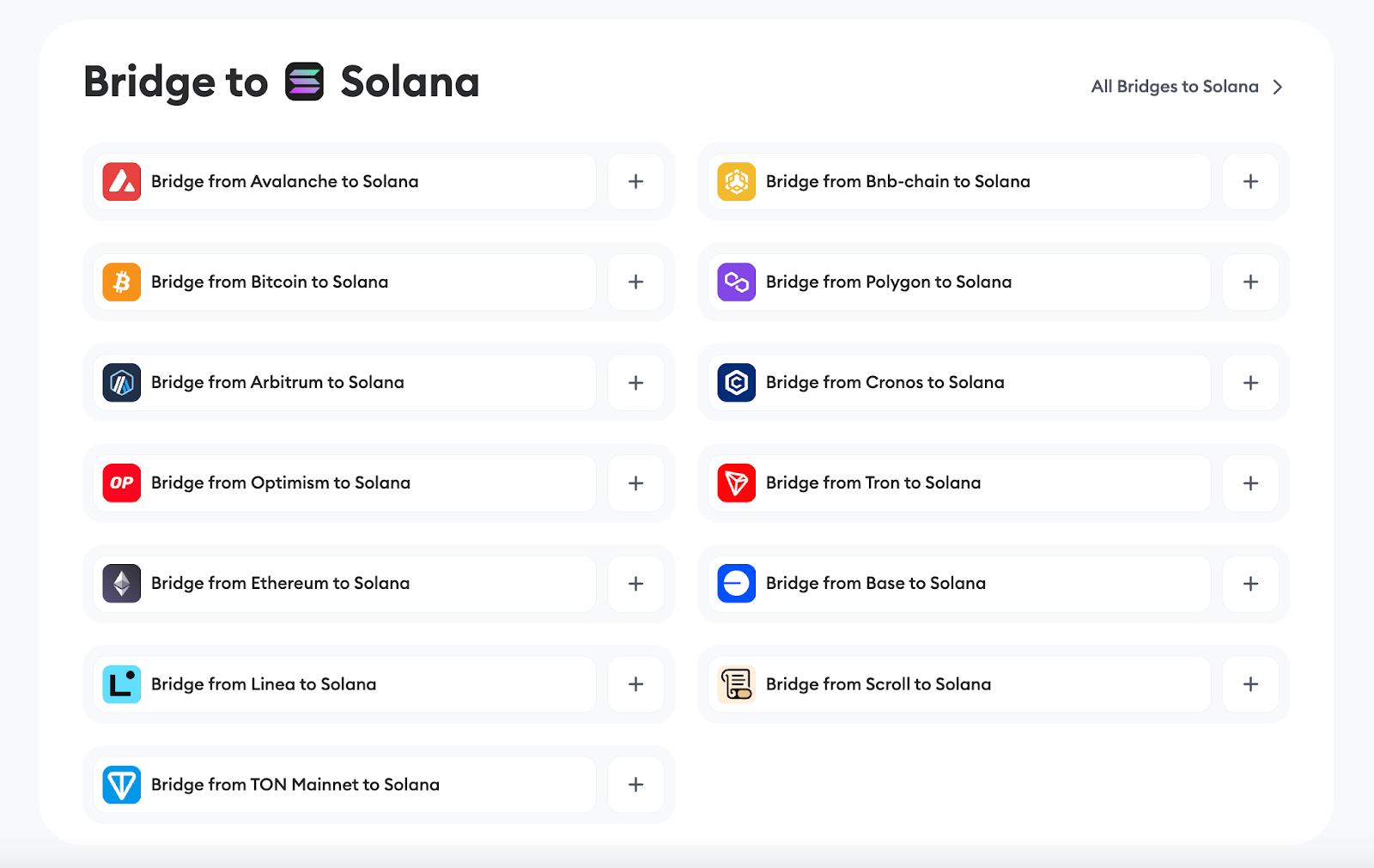
Number of Blockchains Supported: Over 10
The Defiway cross-chain bridge is a great option for users looking to quickly and cheaply bridge from/to Solana.
It has the fastest exchange speed and low exchange fees. The commission is only 0.2% of the transaction amount and the transactions are almost instantaneous. Defiway also has a convenient mobile wallet app.
Defiway is one of the few bridges which supports not only various EVM networks, but also Tron and Solana.
Portal
Number of Blockchains Supported: Over 10
Cross-chain bridge that provides users with a simple and secure way to transfer assets between different blockchains. Portal supports a wide range of networks and offers competitive fees. It also provides a user-friendly interface and detailed transaction tracking.
Rubic
Number of Blockchains Supported: Over 50
User-friendly interface, extensive network support, fast transaction speeds, and low fees. Rubic also offers a swap aggregator that finds the best rates across various decentralized exchanges.
Symbiosis
Number of Blockchains Supported: Over 10
Multi-chain liquidity protocol. Symbiosis enables seamless asset transfers and swaps across various blockchains, including Solana. It also offers a liquidity mining program to incentivize users to provide liquidity to the protocol.
Allbridge
Number of Blockchains Supported: Over 20
Supports a wide range of blockchains, including Solana, Ethereum, Binance Smart Chain, and Polygon. Allbridge is known for its reliable and efficient services, and it also offers a cross-chain asset management platform.
Carrier
Number of Blockchains Supported: Over 10
Decentralized bridge focused on security and reliability. Carrier uses a multi-signature mechanism to ensure the safety of funds. It also offers a bridge explorer to track transactions and bridge status.
Mayan
Number of Blockchains Supported: Over 7
Unique cross-chain swap auction protocol. Mayan allows users to swap assets across different chains in a decentralized and efficient manner. It uses a Dutch auction mechanism to determine the final swap price.
Nitro
Number of Blockchains Supported: Over 10
A high-performance cross-chain bridge that focuses on speed and efficiency. Nitro is designed for large-scale transfers and supports a wide range of blockchains, including Solana. Nitro also offers a user-friendly interface and detailed transaction tracking.
Which bridge to choose for bridging Solana
There are indeed many bridges on Solana, but not all of them can combine high speed, reliability and low commissions.
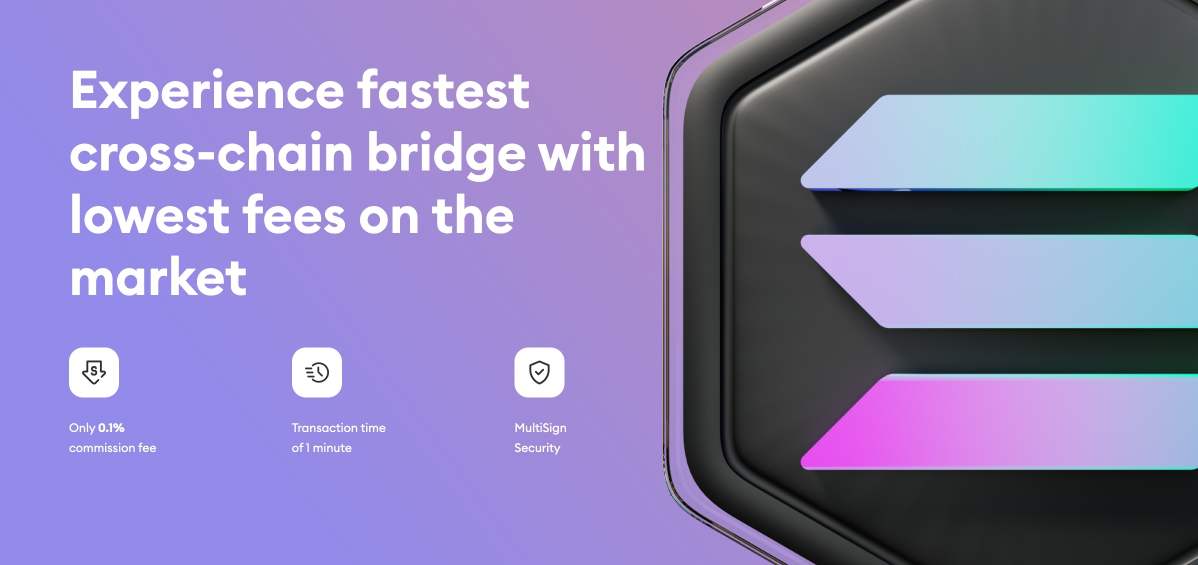
Defiway should be singled out. This bridge has no problems with liquidity, so you can swap any amounts. Speed and fees are also among the best. And the support of the Tron network clearly distinguishes this bridge among the others.