


Need to bridge ETH or USDG to Robinhood Chain? This guide explains the fastest supported routes, fees, compatible wallets, and common mistakes to avoid.
Robinhood Chain is an Ethereum Layer 2 designed to support onchain financial services, tokenized real-world assets and decentralized applications.
The network is built using Arbitrum technology, remains compatible with Ethereum wallets and smart contracts and uses ETH as its native gas token. Robinhood Chain mainnet operates under Chain ID 4663.
As the network develops, users need a practical way to move assets between Robinhood Chain and the rest of the crypto market. Defiway connects Robinhood Chain with major EVM ecosystems as well as Tron, TON and Solana.
Users can bridge to ETH and USDG on Robinhood Chain or transfer them back to another supported network with a fixed 0.2% bridge fee.
What Is Robinhood Chain?
Robinhood Chain is a permissionless Ethereum-compatible Layer 2 built on Arbitrum infrastructure.
Instead of processing every transaction directly on Ethereum mainnet, the network executes activity on its own Layer 2 while using Ethereum for settlement and data availability. This architecture is designed to provide lower transaction costs and faster execution while retaining compatibility with the Ethereum ecosystem.
Robinhood Chain can be used with familiar EVM tools and wallets, including MetaMask and other Ethereum-compatible applications.
The official network parameters are:
- Network name: Robinhood Chain
- Chain ID: 4663
- Native gas token: ETH
- RPC: https://rpc.mainnet.chain.robinhood.com/
- Block explorer: https://robinhoodchain.blockscout.com
What Assets Can You Bridge to Robinhood Chain With Defiway?
Defiway currently supports two assets for Robinhood Chain transfers:
- ETH
- USDG
Both assets can be transferred to Robinhood Chain and from Robinhood Chain back to another supported network.
Defiway announced Robinhood Chain routes for:
EVM Network
- Ethereum
- BNB Chain
- Arbitrum
- Base
- Polygon
- Linea
Non-EVM Networks
- Tron
- TON
- Solana
This means users are not limited to an Ethereum-to-Robinhood route. ETH and USDG can be moved between Robinhood Chain and all networks included in the Defiway integration, including Tron, TON and Solana.
The live bridge interface should always be treated as the final source for current route availability and operational limits.
What Is USDG?
USDG, or Global Dollar, is a US dollar-pegged stablecoin issued by Paxos.
USDG is backed one-to-one and is redeemable from Paxos for US dollars under the issuer's applicable conditions. Paxos also publishes reserve information for its issued stablecoin
USDG launched natively on Robinhood Chain on July 1, 2026. It became the first stablecoin natively issued on the network and the default lending asset for Robinhood Earn.
Why Bridge ETH to Robinhood Chain?
ETH is the native gas token of Robinhood Chain.
You need ETH to pay for actions such as:
- Sending tokens
- Swapping assets
- Interacting with decentralized applications
- Depositing assets into lending protocols
- Withdrawing assets through a bridge
- Approving smart contract interactions
A wallet may already contain USDG but still be unable to perform any onchain action if it has no ETH for gas.
For this reason, users bridging USDG to a new Robinhood Chain address should also consider transferring a small amount of ETH to the same wallet.
Why Bridge USDG to Robinhood Chain?
USDG is one of the core stablecoin assets available on Robinhood Chain.
It can be used for:
- Dollar-denominated transfers
- Stablecoin settlement
- Trading on supported decentralized exchanges
- Lending and borrowing
- Accessing compatible onchain financial applications
- Holding a reserve-backed dollar asset without direct exposure to ETH volatility
Because USDG is issued natively on Robinhood Chain, users can receive an official Robinhood Chain version rather than relying on an unofficial token with a similar name.
What You Need Before Bridging
Prepare the following before starting the transaction.
1. ETH or USDG on a Supported Network
Your assets must be held on one of the networks available for the selected Defiway route:
- Ethereum
- BNB Chain
- Arbitrum
- Base
- Polygon
- Linea
- Tron
- TON
- Solana
The available source asset must match the token selected inside the bridge interface.
2. A Compatible Wallet
Your wallet must support the source network.
Common examples include:
- MetaMask or another EVM wallet for Ethereum, BNB Chain, Arbitrum, Base, Polygon and Linea
- TronLink or another compatible wallet for Tron
- Phantom or another compatible wallet for Solana
- A TON-compatible wallet for TON
Defiway also supports several wallet connection methods depending on the selected network.
3. A Robinhood Chain Address
Robinhood Chain uses EVM-compatible addresses beginning with 0x.
In many cases, the same wallet address can be used across Ethereum, BNB Chain, Arbitrum, Base, Polygon, Linea and Robinhood Chain. However, the networks remain separate. Seeing the same address does not mean that assets held on one chain automatically exist on another.
4. Native Gas on the Source Network
You need enough of the source blockchain's native token to submit the transaction.
Depending on the network, this may include:
- ETH on Ethereum, Arbitrum, Base or Linea
- BNB on BNB Chain
- POL on Polygon
- TRX on Tron
- TON on TON
- SOL on Solana
The gas charge is paid to the source blockchain and is separate from the Defiway bridge fee.
How to Bridge ETH or USDG to Robinhood Chain
Step 1: Open Defiway Bridge
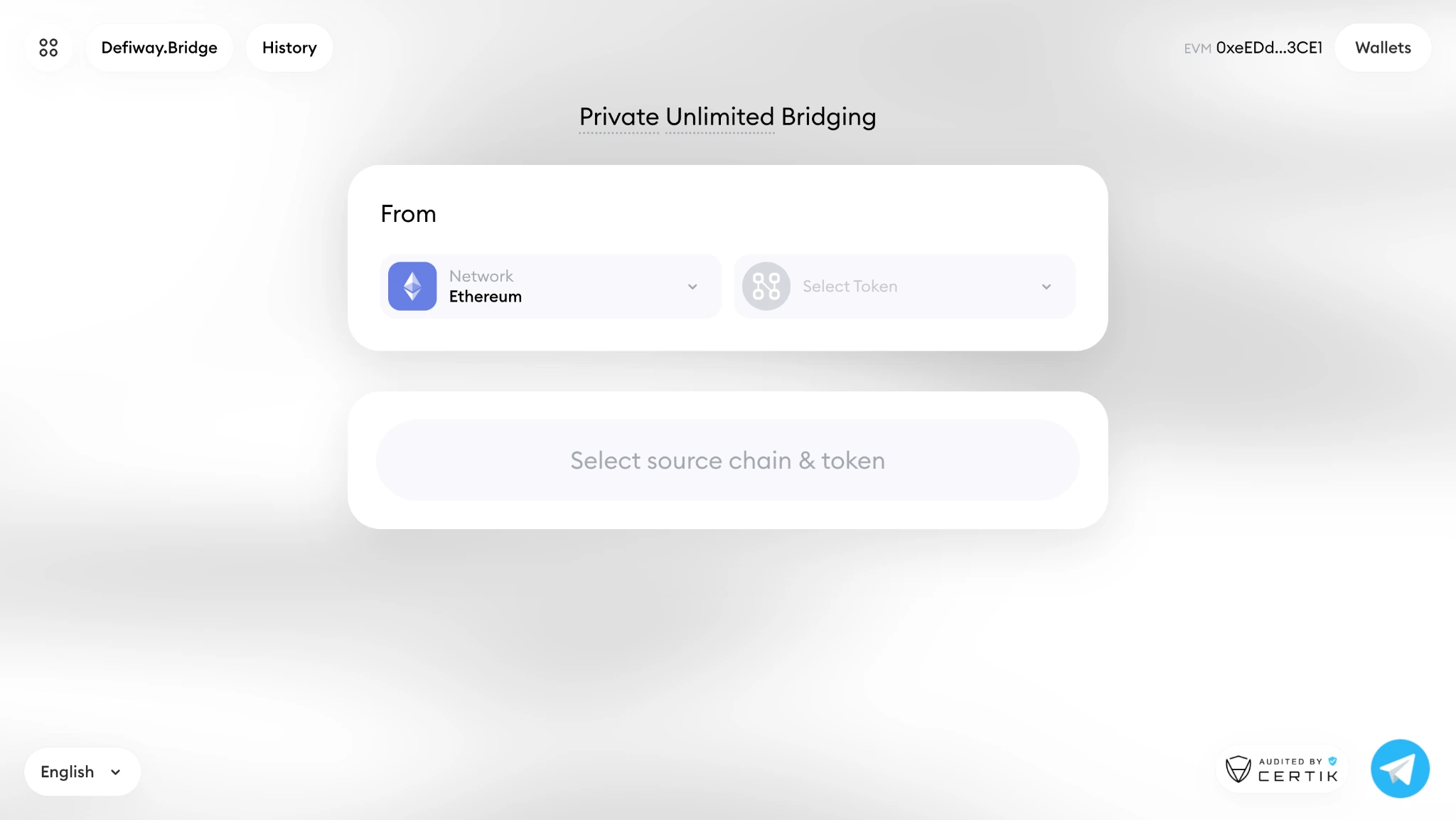
Open the official Defiway Bridge interface.
Check the domain before connecting a wallet or copying a deposit address. Avoid bridge links sent by unknown accounts, private messages or unofficial support representatives.
Step 2: Choose the Source Network
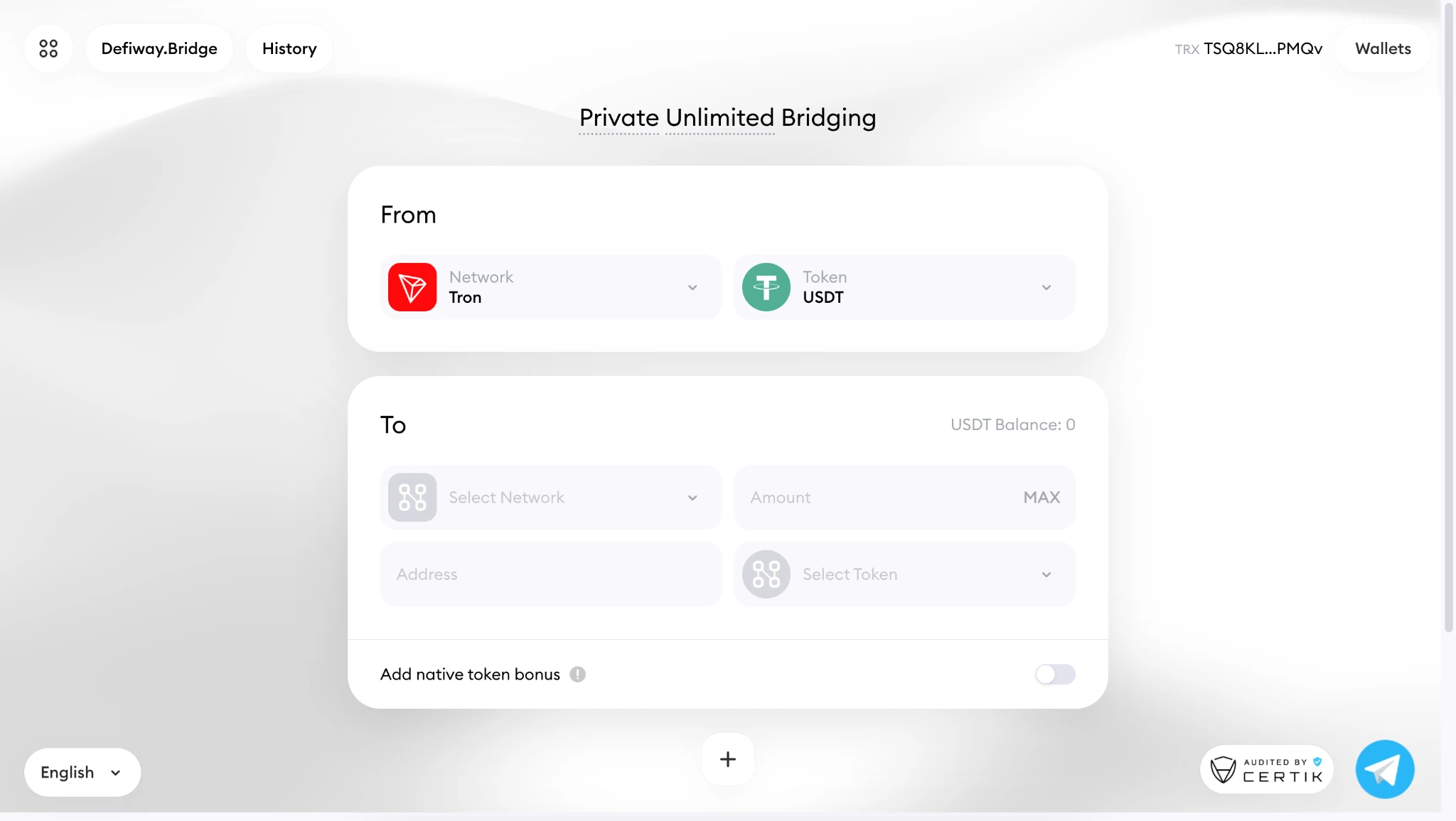
Select the blockchain where your ETH or USDG is currently held.
Make sure you select the actual network holding the funds. ETH on Ethereum and ETH on Arbitrum are not the same blockchain balance.
Step 3: Select Robinhood Chain as the Destination

Choose Robinhood Chain in the destination network field.
Check the destination carefully before proceeding. A valid EVM address alone does not confirm that the correct destination network has been selected.
Step 4: Select ETH or USDG
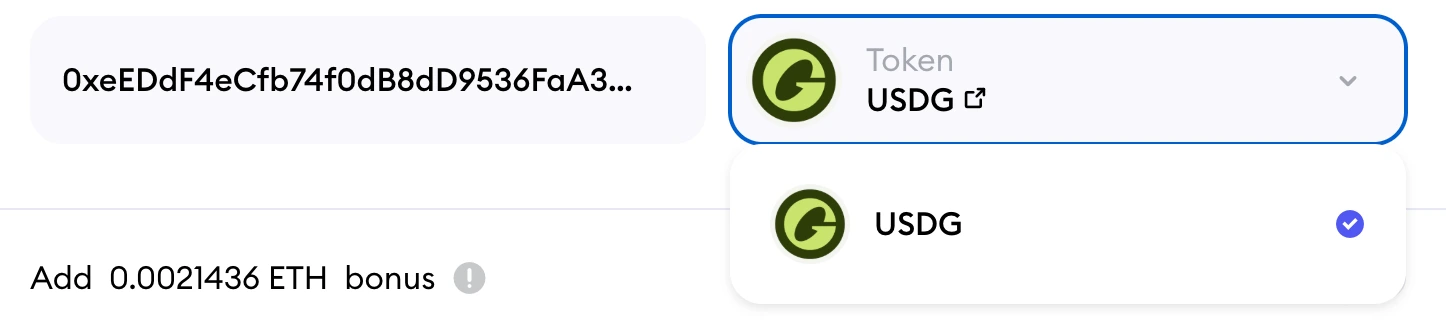
Choose the asset you want to transfer:
- Select ETH when you need Robinhood Chain gas or ETH liquidity
- Select USDG when you need a dollar-denominated stablecoin
Only use the asset options displayed for the selected route.
Step 5: Enter the Transfer Amount
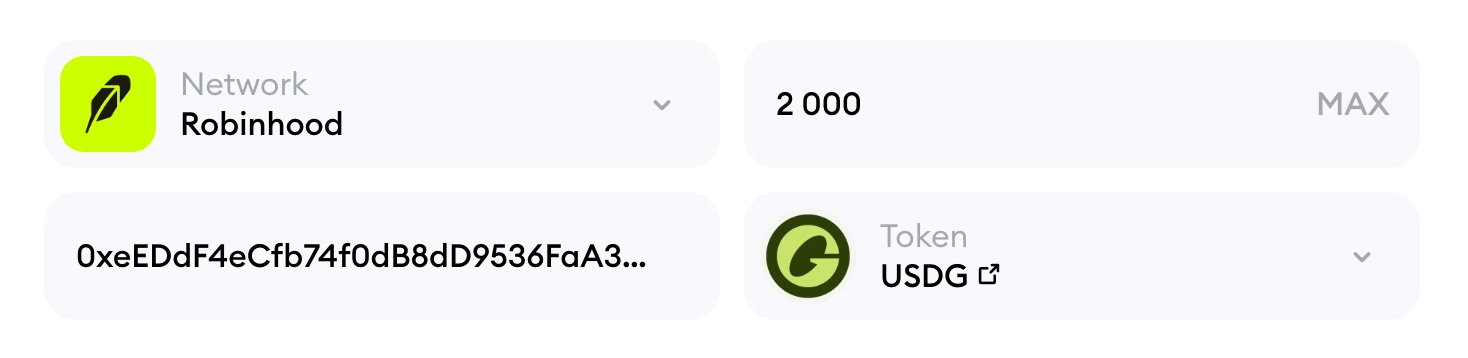
Enter the amount you want to bridge.
Defiway applies a fixed 0.2% service fee for supported cross-chain transfers. Blockchain gas fees are calculated separately and depend on the source network.
Step 6: Enter or Confirm the Receiving Address
Provide the EVM address that will receive the assets on Robinhood Chain.
Check the complete address rather than relying only on its first and last characters. Malware can replace copied wallet addresses with similar-looking addresses.
When transferring to a new wallet or using a route for the first time, consider making a smaller test transaction before sending the main amount.
Step 7: Review the Transaction
Before confirming, verify:
- The source network is correct
- Robinhood Chain is selected as the destination
- The token is ETH or USDG
- The amount is correct
- The receiving address is correct
- The wallet contains enough native gas
- The estimated received amount is acceptable
Defiway displays applicable fees before the transaction is submitted.
Step 8: Submit the Transaction
Confirm the transaction according to the instructions displayed by Defiway and your wallet.
Wait until the source transaction has been broadcast. Save the transaction hash so that you can track the transfer through the appropriate blockchain explorer.
Step 9: Wait for Network Confirmations
Actual completion time depends on the source blockchain, required confirmations, network congestion and the selected route.
A transfer taking longer than one minute does not automatically mean that the funds are lost.
First check whether the source transaction has been confirmed.
Step 10: Check the Balance on Robinhood Chain
Switch your wallet to Robinhood Chain and check the received balance.
If USDG does not appear automatically:
- Check the receiving address in the Robinhood Chain explorer
- Confirm that the USDG balance exists onchain
- Verify the official USDG contract
- Import the verified contract into the wallet
Do not repeat the bridge transaction simply because a wallet interface has not updated.
How to Bridge From Robinhood Chain
Defiway supports transfers in both directions.
To bridge ETH or USDG from Robinhood Chain:
- Connect the wallet holding the assets
- Select Robinhood Chain as the source
- Choose Ethereum, BNB Chain, Arbitrum, Base, Polygon, Linea, Tron, TON or Solana as the destination
- Select ETH or USDG
- Enter the amount
- Verify the receiving address
- Review the fees and estimated received amount
- Submit the transaction
- Track it until the destination funds arrive
The wallet must contain enough ETH on Robinhood Chain to pay for the outgoing transaction.
Defiway announced these routes for any direction, allowing users to enter Robinhood Chain and transfer supported assets back out without being restricted to Ethereum.
Defiway Fees for Robinhood Chain Transfers
The total cost can include two main components.
Defiway Bridge Fee
Defiway charges a fixed fee of 0.2%.
For example:
- 100 USDG transfer: 0.20 USDG service fee
- 1,000 USDG transfer: 2 USDG service fee
- 10,000 USDG transfer: 20 USDG service fee
The final received amount may also be affected by source-chain gas and the specific route shown before confirmation.
Blockchain Gas Fee
The source network charges its own transaction fee.
Gas costs vary between networks and can change depending on activity. Ethereum mainnet will often cost more than Layer 2 networks or networks such as Tron, TON and Solana.
All available charges should be reviewed before submitting the transaction.
Defiway vs the Robinhood Canonical Bridge
Robinhood Chain also has a canonical bridge connecting it directly with Ethereum.
The canonical bridge is the native trust-minimized route. Ethereum deposits typically take around ten minutes, while withdrawals from Robinhood Chain to Ethereum require a standard seven-day Arbitrum challenge period followed by a separate claim transaction on Ethereum.
Defiway differs in several practical ways:
- It supports more than an Ethereum-only route
- It connects Robinhood Chain with six major EVM networks
- It also supports Tron, TON and Solana
- Transfers are available in both directions
- Users can bridge ETH and USDG
- The service fee is fixed at 0.2%
The canonical bridge may suit users who specifically want the native Ethereum-to-Robinhood security model. Defiway is more practical when speed, predictable pricing and broader network coverage are the priority.
Conclusion
Defiway provides a direct way to bridge ETH and USDG between Robinhood Chain and Ethereum, BNB Chain, Arbitrum, Base, Polygon and Linea.
The integration also includes three major non-EVM ecosystems:
- Tron
- TON
- Solana
Transfers are available to Robinhood Chain and from Robinhood Chain back to any supported destination, with a fixed 0.2% Defiway fee.
The most important detail to remember is gas. Robinhood Chain uses ETH as its native token. Users bridging USDG should ensure that the receiving wallet also has enough ETH to perform future transactions.